


Businesses use proxies datacenter servers to collect public information, check websites from different locations and test online services. Datacenter proxies offer speed and relatively low cost, but are not suitable for every website.
What Are Datacenter Proxies?
A proxies datacenter is an intermediary server that forwards requests through an IP address supplied by a hosting company, cloud provider or data centre. The destination website sees this proxy IP instead of the address assigned to your own connection.
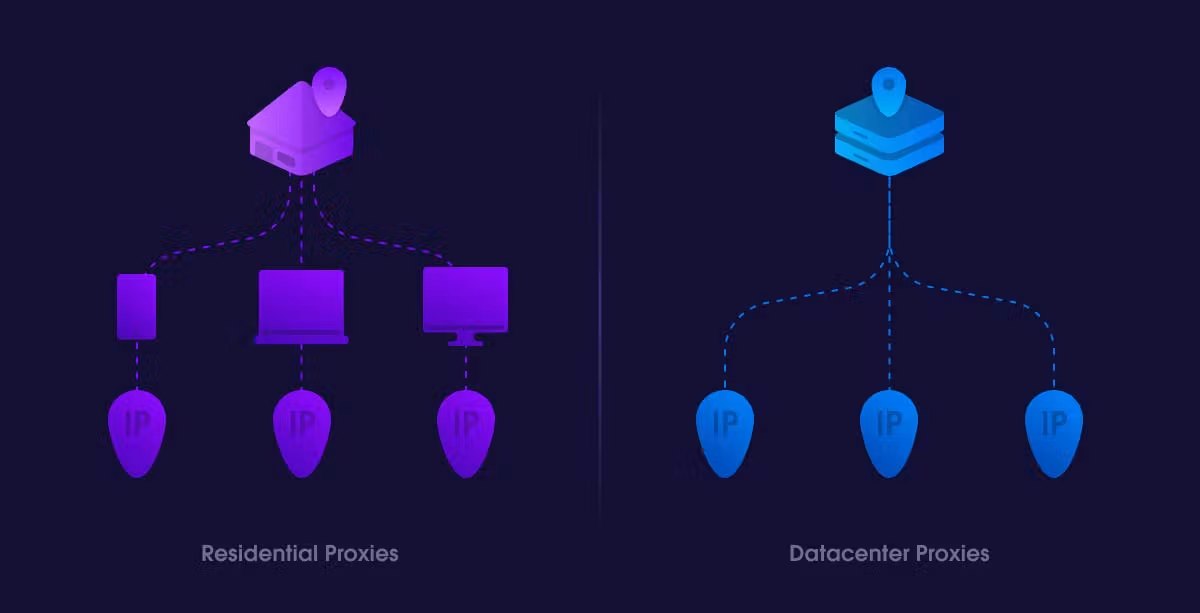
Residential proxies use IP addresses associated with consumer connections. Datacenter addresses belong to server infrastructure and can be identified by websites.
How Do Datacenter Proxies Work?
An application or browser sends a request to the proxy. The proxy forwards it to the destination website using its public IP address. The response returns through the proxy to the original application.
For example, a UK retailer could use a French proxy IP to view public product pages as a visitor in France might. It changes the apparent network location, not necessarily the page content.
Different Types of Datacenter Proxies
The main options differ in how an IP is shared and whether it changes.
- Shared proxies: Multiple customers use the same address or pool. They cost less, but other users can affect IP reputation and capacity.
- Dedicated proxies: An address is reserved for one customer, offering greater control. It remains identifiable as a datacenter IP.
- Static proxies: The same IP is retained between connections, useful when a task needs a consistent network identity.
- Rotating proxies: The service changes the outgoing IP after each request or a chosen interval. Sticky sessions keep one address for a limited period.
These features can overlap: a dedicated proxy may be static, while a rotating service may use a shared pool.
Datacenter Proxies vs Residential Proxies
The key difference is the IP source. Datacenter IPs come from hosting or cloud networks; residential IPs are associated with consumer connections.
Datacenter proxies are often faster proxies datacenter, more consistent and cheaper. They suit workloads on websites that accept server traffic. Residential proxies may offer wider geographic coverage and work better when a website restricts hosting networks. Their connections can vary, and they often cost more.
Neither type guarantees access. Websites assess IP reputation, request frequency and browser signals. Choose according to your target.
Benefits and Limitations
Datacenter proxies offer speed, predictable infrastructure and cost efficiency for repeatable checks and larger workloads. Dedicated addresses provide a consistent connection.
The main limitation is network recognition. Some websites identify hosting-provider IP ranges and respond with verification checks, restrictions or blocks. Shared addresses may have an uncertain history, and many IPs from one provider can still belong to a recognisable network.
Rotation is not a universal fix. It may help with simple per-IP request limits, but changing addresses does not make a datacenter network appear residential or guarantee success.
Common Uses of Datacenter Proxies
Datacenter proxies support public web scraping, price monitoring and market research when a website permits automated access. SEO teams use them to check search results, monitor rankings and review public pages from selected locations. Developers can test websites and APIs from different IP addresses, while site owners can monitor their own services.
Before collecting information, review website terms and applicable laws. Use reasonable request rates and respect access restrictions.
How to Choose the Right Datacenter Proxy
Start with the task. A dedicated static proxy suits workflows needing one consistent address. A rotating pool may suit separate requests on sites that allow them. Shared proxies work for basic tasks, but check how many customers use each address.
Compare locations, protocols, authentication, uptime and support. Test a sample before buying. Measure accurate responses, not speed alone. If a website rejects hosting IPs, consider a residential or ISP proxy.
Final Thoughts
Datacenter proxies are useful when speed, cost and stable connections matter more than appearing to use a household network. They support scraping, SEO checks, research and testing, but their IPs may be recognised or blocked. Match the proxy to the website, test it and collect data responsibly.
Frequently Asked Questions
Are datacenter proxies faster than residential proxies?
Often. Server infrastructure can provide faster, more consistent connections, although performance varies.
Can websites detect datacenter proxies?
Yes. Websites can use IP ownership and reputation to identify or restrict datacenter traffic.
Are rotating datacenter proxies harder to detect?
Rotation changes the IP address, not its network origin. It may help with basic request limits but does not guarantee access.
