


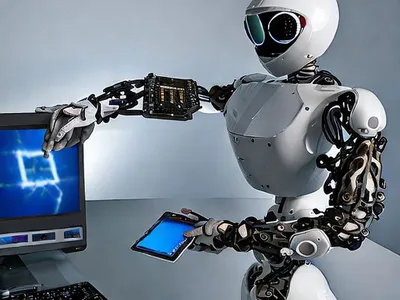
Artificial intelligence (AI) is transforming how people work, communicate and use technology. From smartphone assistants and online recommendations to healthcare research and business automation, AI is becoming an important part of everyday life.
But what exactly is artificial intelligence, and how does it work? Understanding its basic principles can help individuals and businesses recognise its benefits, applications and limitations.
What Is Artificial Intelligence?
Artificial intelligence is a branch of computer science that focuses on developing systems capable of performing tasks associated with human intelligence. These include learning, problem-solving, recognising patterns, understanding language and making predictions.
For example, email services use AI to detect spam, navigation applications analyse traffic to suggest routes, and online platforms recommend products based on user behaviour.
AI systems do not necessarily think like humans. They process information using algorithms and trained models to produce useful results.
How Does Artificial Intelligence Work?
Artificial intelligence works by combining data, algorithms and computing power. Many modern AI systems use machine learning to identify patterns and improve their performance.
The process generally involves three stages:
- Data collection: The system receives information such as text, images, audio or numerical records.
- Training: Algorithms analyse the information and learn patterns that help the model perform a particular task.
- Generating results: The trained model processes new information and produces predictions, recommendations or other outputs.
For example, a fraud detection system can analyse financial transactions and identify unusual activity that may require investigation.
Different Types of Artificial Intelligence
AI includes several technologies and approaches, each serving different purposes.
Narrow AI: Designed to perform specific tasks, such as voice recognition, facial recognition and recommendation systems. Most AI applications currently in use belong to this category.
Artificial General Intelligence (AGI): A theoretical form of AI that could perform a broad range of intellectual tasks at a level comparable to humans. It has not yet been achieved.
Machine Learning: A branch of AI that enables systems to learn patterns from data and make predictions without relying entirely on manually programmed rules.
Deep Learning: A specialised form of machine learning that uses multi-layered neural networks to process complex information, including images, speech and language.
Generative AI: Technology that creates new content, including text, images, audio and computer code, based on patterns learned during training.
Common Applications of Artificial Intelligence
AI is used across different industries and everyday activities.
- Everyday life: Search engines, smartphone assistants, navigation applications and streaming recommendations use AI technologies.
- Healthcare: AI can support medical image analysis, research and administrative tasks, helping healthcare professionals examine information.
- Education: AI-powered tools assist students with learning, research, language practice and understanding difficult subjects.
- Business: Organisations use AI for customer support, sales forecasting, data analysis and repetitive task automation.
- Cybersecurity: Security systems use AI to identify unusual network activity, detect suspicious behaviour and support threat investigations.
These applications can improve efficiency, but important decisions still require appropriate human oversight.
Advantages of Artificial Intelligence
Artificial intelligence offers several benefits when used correctly:
- Automates repetitive tasks and saves time.
- Processes large amounts of information quickly.
- Supports business planning and decision-making.
- Improves personalised recommendations.
- Helps identify patterns that may be difficult to recognise manually.
- Supports services that operate around the clock.
Disadvantages and Risks of Artificial Intelligence
Despite its advantages, AI also presents challenges.
AI systems can produce inaccurate information, particularly when their training data or inputs are unreliable. Privacy is another concern because some applications process personal or confidential information.
Bias in training data may also lead to unfair results. Additionally, AI can be misused for phishing, deceptive content and other cybersecurity threats.
Businesses should consider data protection, security, fairness and human supervision before implementing AI solutions.
Artificial Intelligence vs Machine Learning: What’s the Difference?
Artificial intelligence is the broader field of developing computer systems capable of performing intelligent tasks. Machine learning is a part of AI that allows systems to learn from data.
For example, an AI-powered virtual assistant may use machine learning to understand questions and generate relevant responses.
In simple terms, all machine learning belongs to the wider AI field, but not every AI system necessarily uses machine learning.
The Future of Artificial Intelligence
Artificial intelligence is expected to play an increasingly important role in business, education, healthcare and scientific research. Generative AI and AI agents are also creating new ways to produce content and automate digital tasks.
However, future progress will depend on responsible development, reliable information, privacy protection and effective regulation.
Frequently Asked Questions
What is artificial intelligence in simple words?
Artificial intelligence is technology that enables computers to perform tasks such as learning, recognising patterns and making predictions.
Is ChatGPT an example of AI?
Yes. ChatGPT is an AI-powered conversational system that uses generative AI to produce responses and assist with different tasks.
Can AI replace human jobs?
AI can automate certain tasks and change job responsibilities, but human judgement, creativity and communication remain important.
Final Thoughts
Artificial intelligence is changing how people interact with technology and how businesses manage their operations. Understanding its types, applications and limitations helps users make informed decisions about adopting AI.
When supported by reliable information and appropriate human oversight, artificial can become a valuable tool for productivity, innovation and problem-solving.
