


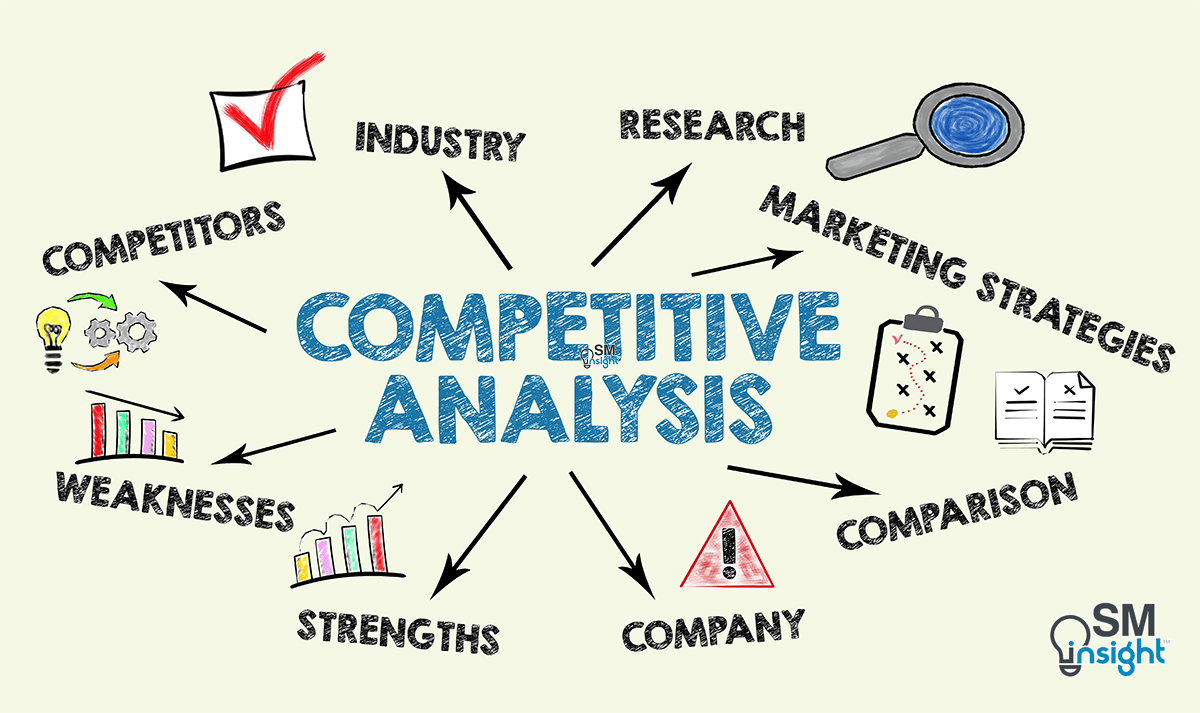
Businesses rarely compete on just one thing Competitive Analysis. A customer may compare your product with another company’s pricing, features, reviews, website, content, reputation, customer support, and overall experience before making a decision.
That is why competitive analysis is more useful than simply making a list of companies you consider rivals. Done properly, it helps you understand how customers see the market, where competitors are stronger or weaker, which opportunities are being overlooked, and what your business should do next.
This guide explains what competitive analysis is, what to investigate, how to perform it step by step, which tools can help, and how to turn research into practical business and marketing decisions.
What Is Competitive Analysis?
Competitive analysis is the systematic process of identifying competitors, researching their products, positioning, marketing, customer experience, strengths, weaknesses, and market activity, then comparing those findings with your own business.
The purpose is not to copy competitors. It is to understand the market well enough to make better decisions about products, pricing, marketing, SEO, customer experience, and positioning.
A useful competitive analysis should answer questions such as:
- Who are we really competing with?
- Why do customers choose them?
- What do they offer that we do not?
- Where are they weaker?
- Which audiences or needs are underserved?
- What are they doing successfully?
- Which of their strategies would not make sense for us?
- What should we change based on the evidence?
The best analysis therefore ends with decisions, not just a spreadsheet full of competitor data.
Why Does Competitive Analysis Matter?
Competitive research gives businesses context. Your own metrics can tell you whether something is improving, but competitor information can help explain what is happening in the wider market.
For example, if your sales are declining, several explanations are possible:
- A competitor may have introduced a cheaper plan.
- A new product may have changed customer expectations.
- Customers may be searching for a different solution.
- A competitor may have improved its distribution.
- Your messaging may no longer communicate a clear advantage.
- An emerging company may be targeting a segment you previously dominated.
Competitive analysis helps investigate these possibilities instead of relying on assumptions.
It can support decisions involving:
Product development
Identify missing features, common complaints, usability problems, and areas where customers want better solutions.
Pricing
Understand how competitors structure plans, discounts, packages, subscriptions, and premium offerings.
Marketing
See which messages, channels, campaigns, and content themes competitors use to attract attention.
SEO
Discover keyword opportunities, competing pages, content gaps, search intent, and websites linking to competing businesses.
Sales
Understand competitor positioning and the objections your sales team may encounter during customer conversations.
Positioning
Find a meaningful reason for customers to choose your business instead of simply trying to become a cheaper or larger version of a competitor.
Competitive Analysis vs. Competitor Analysis vs. Competitive Intelligence
These terms are related, but they are not always interchangeable.
| Term | Main focus | Typical use |
|---|---|---|
| Competitive analysis | Structured comparison of your business and competitors | Strategy, marketing, product and positioning decisions |
| Competitor analysis | Detailed investigation of individual competitors | Understanding specific rivals |
| Competitive research | Gathering information about competitors and the market | Research and discovery |
| Competitive intelligence | Turning competitive information into strategic insight | Ongoing decision-making and market monitoring |
| Market research | Understanding customers, markets, demand and trends | Broader business and product decisions |
A competitor analysis might tell you that a rival publishes twice as many articles as you do.
Competitive intelligence asks the more useful question:
Why does that matter, and what should we do about it?
That distinction is important. More competitor data does not automatically produce better strategy.
Direct vs. Indirect Competitors
Not every competitor deserves the same level of attention.
Direct competitors
Direct competitors offer a similar product or service to a similar audience and compete for the same buying decision.
For example, two project-management platforms targeting small businesses could be direct competitors.
Indirect competitors
Indirect competitors solve a similar customer problem through a different product, service, or approach.
A project-management platform may compete indirectly with spreadsheets, communication tools, or internal processes.
Emerging competitors
A new entrant may not currently have significant market share but could become important because of a new technology, pricing model, audience, or distribution strategy.
These businesses are easy to overlook because they may not appear in your traditional competitor list.
Aspirational competitors
You can also study companies outside your immediate category that excel at something you want to improve.
For example, a small software company might study a well-known technology brand for onboarding or customer education even if the two businesses do not sell the same product.
The goal is not to monitor every company. Build a competitive set that helps answer the business question you are actually trying to solve.
When Should a Business Conduct a Competitive Analysis?
A competitive analysis is particularly useful when:
- Launching a new business
- Entering a new market
- Launching a product or service
- Changing pricing
- Repositioning a brand
- Losing customers to competitors
- Entering a new geographic market
- Planning a major SEO or content campaign
- Preparing a new marketing strategy
- Experiencing a significant change in customer demand
- Evaluating an acquisition or partnership
- Entering a rapidly changing technology category
It should not be treated as a one-time document.
A practical schedule is:
- Monthly: monitor major competitor changes
- Quarterly: review important marketing, SEO, product and pricing changes
- Annually: conduct a deeper competitive review
- Immediately: reassess when a major market disruption occurs
The right frequency depends on how quickly your industry changes. A stable local business may need less monitoring than an AI or SaaS company operating in a rapidly evolving market.
How to Conduct a Competitive Analysis Step by Step
A useful competitive analysis starts with a question, not a tool.
Before collecting information, decide what you want to learn.
For example:
“Why are three competitors attracting more organic traffic for the services we offer?”
That question produces much more useful research than simply asking:
“What are our competitors doing?”
Here is a practical eight-step process.
1. Define the Objective of Your Analysis
Start by writing down the decision you want the research to support.
Your objective might be:
- Improve product positioning
- Find new SEO opportunities
- Increase conversions
- Understand pricing differences
- Enter a new market
- Improve customer retention
- Develop a new product
- Identify underserved customers
- Improve content strategy
Then choose the metrics that actually relate to that objective.
For example, if your goal is SEO growth, product packaging may still matter, but keyword rankings, search intent, content coverage, backlinks, internal linking and competing pages deserve greater attention.
This prevents your analysis from becoming a collection of interesting but irrelevant facts.
2. Identify the Right Competitors
Do not assume the companies your team talks about internally are your complete competitive set.
Build your list from several sources.
Start with your existing knowledge
Ask:
- Which companies do sales prospects mention?
- Which competitors appear in lost-deal reports?
- Which businesses offer similar products?
- Which brands do customers compare you with?
Search important keywords
Search the phrases customers use when looking for your product or service.
If you sell accounting software, for example, examine searches such as:
- accounting software for small business
- online accounting software
- small business bookkeeping software
- accounting software comparison
The businesses repeatedly appearing for commercially relevant searches may be important SEO competitors even if you have never considered them traditional competitors.
Ask customers
Customer interviews can reveal competitors that internal teams miss.
Useful questions include:
- Which alternatives did you consider?
- What made you compare us with those companies?
- What nearly stopped you from choosing us?
- What would you use if our product were unavailable?
- Which competitor do you think offers the best alternative?
Check review and comparison websites
Comparison pages and review platforms can show which businesses customers naturally group together.
Look for emerging players
Monitor new products, startups, technology changes, and alternative business models.
Your competitor list should be evidence-based rather than based entirely on assumptions.
3. Create a Competitor Comparison Matrix
Once you have your competitors, put the information into a consistent format.
A simple competitive analysis framework might look like this:
| Category | Your Business | Competitor A | Competitor B | Competitor C |
|---|---|---|---|---|
| Target audience | ||||
| Main offer | ||||
| Pricing | ||||
| Key features | ||||
| Positioning | ||||
| Main differentiator | ||||
| Content strategy | ||||
| SEO visibility | ||||
| Social presence | ||||
| Customer reviews | ||||
| Customer support | ||||
| Strengths | ||||
| Weaknesses | ||||
| Market opportunities |
Do not try to measure everything.
Choose categories that help you make the decision identified in step one.
4. Analyze Products and Services
Start with what customers are actually buying.
Compare:
- Core features
- Product quality
- Ease of use
- Performance
- Integrations
- Support
- Delivery or implementation
- Guarantees
- Plans and packages
- Customization
- Limitations
- Additional services
- Onboarding
- Cancellation or switching processes
For software, you could create a feature matrix.
| Feature | Your Product | Competitor A | Competitor B |
|---|---|---|---|
| Feature A | ✓ | ✓ | — |
| Feature B | ✓ | — | ✓ |
| Integration X | — | ✓ | ✓ |
| Free plan | — | ✓ | — |
| Customer support | Chat | Email + Chat |
But a feature comparison alone is not enough.
Ask which features customers actually value.
A competitor having 30 features does not automatically mean it has a better product. If customers consistently use only five features, those five may matter much more to your strategy.
5. Compare Competitor Pricing
Pricing analysis should go beyond writing down the number displayed on a pricing page.
Look at:
- Entry-level price
- Premium price
- Free plans or trials
- Per-user pricing
- Usage-based pricing
- Annual discounts
- Setup fees
- Add-ons
- Enterprise pricing
- Bundles
- Promotional offers
- Cancellation terms
Then ask:
What is the competitor trying to communicate through its pricing?
A low price may communicate accessibility.
A high price may support a premium positioning.
A complicated pricing structure may allow customization but create friction.
Do not automatically respond to a cheaper competitor by lowering your own price. First determine whether customers perceive the two offers as equivalent.
6. Analyze Target Audience and Positioning
Two companies can sell similar products while targeting completely different customers.
Study:
- Who the competitor speaks to
- Industry
- Company size
- Customer maturity
- Geographic market
- Job roles
- Main pain points
- Desired outcomes
- Price sensitivity
- Customer objections
Then examine positioning.
Look at:
- Homepage headline
- Tagline
- Product descriptions
- Calls to action
- Main benefits
- Brand tone
- Customer testimonials
- Case studies
- Guarantees
- Visual identity
Try to complete this sentence for every major competitor:
“This company wants customers to believe that it is the best choice because ______.”
Then complete the same sentence for your business.
If the answers are almost identical, your positioning may not be distinctive enough.
7. Perform an SEO Competitive Analysis
An SEO competitive analysis focuses specifically on how competing websites perform in organic search.
This deserves its own process because the company you compete with commercially may not be the same website competing with you in Google.
Identify SEO competitors
Search your priority keywords and record websites that repeatedly appear.
You can also use SEO platforms to identify websites ranking for similar keywords.
Compare keyword coverage
Look for:
- Keywords they rank for that you do not
- Keywords where both sites rank
- Keywords where you rank below them
- Long-tail searches they target
- Commercial keywords
- Informational topics
- Local search terms
A keyword gap is not automatically an opportunity. Check the search intent first.
Study top-performing pages
For important competing keywords, inspect the pages ranking well.
Ask:
- What question does the page answer?
- How comprehensive is it?
- What format does it use?
- Does it include examples?
- Is the content current?
- Does it provide original information?
- What related questions does it answer?
- What is missing?
Do not copy the competitor’s page. Use the research to understand what the searcher expects and then create something more useful.
Review on-page SEO
Compare:
- Page titles
- H1s and subheadings
- URL structure
- Internal links
- Images
- Structured data where relevant
- Content depth
- Search intent alignment
- Navigation
- Calls to action
Google’s own guidance emphasizes creating helpful, reliable, people-first content rather than trying to manipulate rankings with a formula. Google for Developers
Analyze backlinks
Look at:
- Referring domains
- Editorial links
- Industry publications
- Digital PR coverage
- Resource pages
- Partnerships
- Original research being cited
The objective should not be to reproduce every competitor backlink.
Instead ask:
Why did another website have a reason to link to this competitor?
That answer can reveal opportunities for original research, useful resources, expert commentary, digital PR or stronger content.
8. Analyze Content Strategy
Competitor content can reveal what a market cares about.
Build a list of their major content types:
- Blog articles
- Guides
- Tutorials
- Case studies
- Comparisons
- Product pages
- Reports
- Research
- Videos
- Podcasts
- Webinars
- Tools
- Templates
- News commentary
Then examine performance signals.
For example:
| Content question | What to investigate |
|---|---|
| What topics do they cover? | Main themes and subtopics |
| What formats do they use? | Guides, videos, tools, comparisons |
| What gets engagement? | Comments, shares, discussion |
| What ranks? | Organic visibility |
| What attracts links? | Referring domains and mentions |
| What converts? | Calls to action and product connections |
One of the most valuable findings may be what competitors do not publish.
That is where content gaps can emerge.
Social media should be evaluated for more than follower counts.
Compare:
- Platforms used
- Posting frequency
- Content formats
- Engagement
- Audience responses
- Brand voice
- Community management
- Influencer partnerships
- Educational content
- Promotional content
- Customer complaints
- Recurring topics
Pay particular attention to comments.
A competitor’s social posts may reveal questions, frustrations and product requests that are difficult to discover from its website.
However, do not assume that a large follower count means strong marketing performance. The more useful question is whether the audience is relevant and whether social activity contributes to meaningful business outcomes.
Customer Reviews and Customer Experience
Customer reviews are one of the most valuable sources of competitive intelligence because they show what customers actually experience.
Review:
- Positive reviews
- Negative reviews
- Repeated complaints
- Frequently praised features
- Support experiences
- Delivery problems
- Product quality concerns
- Missing features
- Cancellation issues
Create two lists:
Customers love
What do people repeatedly praise?
Customers dislike
What problems appear repeatedly?
Now compare those lists with your own customer feedback.
This can reveal opportunities that are difficult to see from competitor websites.
For example:
Competitors may advertise “24/7 support,” while reviews repeatedly complain about slow responses.
That does not automatically mean you should make the same claim. But it may indicate an opportunity to differentiate through genuinely faster, clearer support.
Competitor Strengths and Weaknesses
Avoid vague statements such as:
“Competitor A has strong marketing.”
Explain what “strong” means.
A more useful assessment might be:
- Strong organic visibility for commercial keywords
- Clear pricing structure
- Large library of comparison content
- High brand recognition
- Strong customer reviews
- Weak onboarding information
- Limited localization
- Poor explanation of advanced features
Evidence makes the analysis actionable.
Use SWOT Analysis Carefully
A SWOT analysis organizes findings into four categories:
| Positive | Negative | |
|---|---|---|
| Internal | Strengths | Weaknesses |
| External | Opportunities | Threats |
Strengths
What does your business do better?
Weaknesses
Where are competitors consistently stronger?
Opportunities
Which underserved customer needs or market gaps could you pursue?
Threats
Which external changes could make your position weaker?
The important point is that SWOT should summarize research rather than replace it.
A statement such as “strong brand” should be supported by evidence such as awareness, search demand, customer preference, media presence or other relevant signals.
Competitive Analysis Framework: A Simple Working Model
If you need a repeatable framework, use these seven categories:
- Market — Who is competing and what is changing?
- Customer — Who are competitors targeting?
- Offer — What products, services and features do they provide?
- Price — How do their pricing and packaging differ?
- Marketing — How do they attract and persuade customers?
- Experience — What happens before, during and after purchase?
- Opportunity — Where can your business create a meaningful advantage?
For each category, record:
Observation → Evidence → Implication → Action
For example:
Observation: Competitor A ranks for many comparison searches.
Evidence: Its comparison pages appear consistently for several high-intent queries.
Implication: Comparison content is an important part of the category’s buying journey.
Action: Create original comparison resources addressing customer questions competitors leave unanswered.
This turns competitor research into strategy.
Practical Competitive Analysis Example
Imagine a small SaaS company sells an AI-powered email productivity tool.
It has three major competitors.
Step 1: Identify the problem
Organic traffic is growing, but the company is not receiving enough qualified trial users.
Step 2: Research competitors
The team discovers that competitors receive significant visibility from:
- Product comparison pages
- “Best tools” articles
- Email productivity guides
- Integration pages
- Templates
- Customer case studies
Step 3: Examine the customer journey
The competitors do not simply publish blog posts.
They connect educational content to:
Problem → Explanation → Solution → Product → Trial
Step 4: Examine customer complaints
Reviews reveal that some competing products are considered difficult to configure.
Step 5: Find the opportunity
The SaaS company could position itself around:
- Easier setup
- Clearer onboarding
- Useful templates
- Transparent pricing
- Better educational content
Step 6: Turn findings into actions
Instead of copying competitors, the company could:
- Build comparison pages around genuine customer questions.
- Publish setup guides.
- Create templates that solve real problems.
- Improve onboarding.
- Explain pricing more clearly.
- Create content around underserved use cases.
- Measure whether these changes increase qualified trials.
That is the difference between competitive research and useful competitive strategy.
Competitive Analysis Template
You can copy the following structure into a spreadsheet or research document.
Business overview
- Company:
- Website:
- Target market:
- Main product/service:
- Geographic focus:
- Business model:
- Primary positioning:
Product or service
- Main features:
- Unique features:
- Pricing:
- Packages:
- Free trial:
- Guarantees:
- Customer support:
- Integrations:
- Major limitations:
Marketing
- Main message:
- Brand voice:
- Primary channels:
- Content formats:
- Major campaigns:
- Paid advertising:
- Partnerships:
- Social platforms:
SEO
- Main organic competitors:
- Priority keywords:
- Keyword gaps:
- Top pages:
- Content gaps:
- Backlink opportunities:
- Search intent:
- Internal linking:
- Technical observations:
Customer experience
- Reviews:
- Common praise:
- Common complaints:
- Onboarding:
- Support:
- Cancellation:
- Product usability:
Strategic assessment
- Competitor strengths:
- Competitor weaknesses:
- Your strengths:
- Your weaknesses:
- Market opportunities:
- Potential threats:
- Recommended actions:
Useful Tools for Competitive Analysis
The best tool depends on the question you are trying to answer.
Search engines
Google and other search engines are useful for discovering:
- Search competitors
- Content formats
- Commercial pages
- Comparison searches
- New market entrants
SEO platforms
Tools such as Ahrefs, Semrush and Moz can help investigate:
- Keyword rankings
- Competing domains
- Backlinks
- Organic search visibility
- Content opportunities
Google Search Console
Use your own Search Console data to identify queries where your site already has visibility but could potentially improve.
Google Ads Auction Insights
For paid search, Google Ads provides Auction Insights data that can show how your ads compare with other advertisers participating in the same auctions, including metrics such as impression share and position-above rate. Google Help
Technology-detection tools
Technology lookup tools can help identify technologies used by competitor websites.
Review platforms
Use relevant review websites to understand customer sentiment, recurring complaints and product comparisons.
Directly examine competitor accounts rather than relying only on third-party estimates.
Remember: tools provide observations and estimates. They do not automatically provide the explanation behind those numbers.
Common Competitive Analysis Mistakes
1. Tracking too many competitors
Monitoring 30 companies superficially is often less useful than deeply studying five relevant competitors.
2. Copying competitors
A competitor’s strategy may work because of its brand, audience, budget, reputation or business model.
Copying the tactic without understanding the reason behind it can produce poor results.
3. Confusing visibility with success
A competitor may rank well, have many followers or receive substantial media attention without necessarily being more profitable.
Treat visibility metrics as evidence, not proof of business success.
4. Ignoring customers
Competitor websites tell you what companies want people to believe.
Customer reviews can tell you what people actually experienced.
You need both perspectives.
5. Relying on a single data source
Website research, SEO tools, customer interviews, reviews, social media and internal sales information each reveal different parts of the market.
6. Treating the analysis as permanent
A competitive analysis is a snapshot.
Pricing changes. Products change. Search results change. New businesses enter markets. Customer expectations evolve.
7. Collecting data without making decisions
This is perhaps the biggest mistake.
If a research document ends with hundreds of observations but no priorities, it has not yet become a strategy.
How to Turn Competitive Research Into an Action Plan
After collecting your information, rank every important finding according to:
Impact × Confidence × Effort
For example:
| Finding | Potential impact | Confidence | Effort | Priority |
|---|---|---|---|---|
| Missing high-intent content | High | High | Medium | High |
| Competitor has more social followers | Low | High | High | Low |
| Customers complain about competitor onboarding | High | Medium | Medium | High |
| Competitor offers a cheaper plan | Medium | High | High | Medium |
This helps prevent teams from reacting to every competitor move.
Then convert high-priority findings into specific actions.
Instead of:
“Improve SEO.”
Write:
“Create three pages targeting high-intent topics where competitors currently provide incomplete answers, then measure organic impressions, clicks and qualified conversions.”
Instead of:
“Improve customer experience.”
Write:
“Reduce onboarding steps and add a guided setup checklist based on recurring customer questions.”
Specific actions can be assigned, measured and reviewed.
How Often Should Competitive Analysis Be Updated?
There is no universal schedule.
A useful approach is to separate monitoring from deep analysis.
Monthly monitoring
Check for:
- New products
- Major pricing changes
- New content
- Important campaigns
- New competitors
- Significant customer complaints
- Major SEO changes
Quarterly review
Reassess:
- Positioning
- Content strategy
- SEO performance
- Product changes
- Pricing
- Customer experience
- Major opportunities
Annual deep analysis
Review the entire competitive landscape and reconsider whether your competitor set is still accurate.
For rapidly changing industries such as AI and software, more frequent monitoring may be appropriate.
How to Make Competitive Analysis More Accurate
Good research is not only about collecting more information. It is about reducing bad assumptions.
Use these practices:
Separate facts from interpretation
Fact: Competitor A offers three pricing tiers.
Interpretation: The company appears to target different customer segments.
Do not present the second statement as though it were directly observed fact.
Record the source and date
Pricing, features and rankings can change. Note when information was collected.
Compare equivalent metrics
Do not compare your internal revenue with an estimated competitor figure and treat both as equally precise.
Look for patterns
One negative review may be noise.
Repeated complaints across many customers deserve attention.
Test important assumptions
If you believe a competitor is winning because of price, verify whether customers actually mention price as the reason.
Keep your own goals visible
Competitor analysis should support your strategy rather than replace it.
What Competitive Analysis Can Reveal That Ordinary Market Research Misses
Competitive research becomes especially powerful when you compare different information sources.
For example:
Competitor website: “Fast customer support.”
Customer reviews: Complaints about slow replies.
Job listings: Competitor is hiring a large customer-support team.
Your customer interviews: Customers repeatedly mention support as a deciding factor.
Strategic opportunity: Customer support may be a meaningful differentiation point.
This kind of cross-checking is more valuable than simply counting competitor features.
Internal Linking Opportunities for TechMorrow
TechMorrow currently publishes content around AI, software, emerging technology, SaaS and virtual assistants, making several existing articles natural contextual links for this topic. TechMorrow
Suggested placements:
- “MVP development” → link to TechMorrow’s existing article, “MVP Development in 2026: How to Launch Without a Dev Team in 2026” when discussing competitive analysis before launching a digital product.
- “Micro SaaS ideas” → link to “12 Micro SaaS Ideas You Can Build Solo in No Time” when discussing competitor research for new SaaS businesses.
- “AI agents” → link to “Building a team of AI agents and human Virtual Assistants for 24/7 operations” when discussing emerging competitors and technology-driven market changes.
- “AI-powered email agents” → link to “Email for AI Agents: How It Works and How To Set It Up” when discussing technology and product comparisons.
- “Virtual assistants and AI” → link to “How Virtual Assistants Are Using AI to Double Their Output in 2026” when discussing technology trends affecting competitive positioning.
These pages are verified on TechMorrow’s current website. TechMorrow
Recommended External Resources
For readers who want to go deeper, authoritative resources can be linked where relevant:
- Google Search Central for Google’s SEO guidance and people-first content principles. Google Search Central SEO Starter Guide
- Google Ads Help for understanding Auction Insights and paid-search competitor visibility. Google Ads Auction Insights
- Google Search Essentials for Google’s current search-related technical and spam guidance. Google Search Essentials
Use external references when they genuinely help the reader verify a claim or perform a task. There is no benefit in adding links simply to increase the number of external links.
Frequently Asked Questions About Competitive Analysis
What is the main purpose of competitive analysis?
The main purpose of competitive analysis is to understand how your business compares with competitors and use that information to make better decisions. It can reveal differences in products, pricing, positioning, marketing, SEO, customer experience, strengths, weaknesses and market opportunities.
What are the five main steps of competitive analysis?
A basic process is to identify competitors, collect relevant information, compare products and strategies, evaluate strengths and weaknesses, and turn the findings into actions. A more detailed analysis can add customer research, SEO, pricing, content, social media and ongoing market monitoring.
What should be included in a competitive analysis?
A competitive analysis can include competitor profiles, products and services, pricing, target audiences, positioning, marketing, content, SEO, backlinks, social media, customer reviews, customer experience, strengths, weaknesses, opportunities and threats.
What is a competitive analysis framework?
A competitive analysis framework is a structured method for collecting and comparing competitor information. A practical framework can organize research around market, customer, product, pricing, marketing, customer experience and strategic opportunities.
What is an SEO competitive analysis?
An SEO competitive analysis examines websites competing for the same search visibility. It can include keyword rankings, search intent, competing pages, content gaps, on-page optimization, internal linking, backlinks and technical factors.
How many competitors should you analyze?
There is no universal number. For many small and medium-sized projects, a focused group of several major direct competitors plus a few indirect or emerging competitors provides enough information without making the research unmanageable.
Is competitor analysis the same as SWOT analysis?
No. SWOT is a framework for organizing strengths, weaknesses, opportunities and threats. Competitor analysis is the broader research process that can provide evidence for a SWOT assessment.
How often should competitive analysis be done?
Competitive analysis should be updated according to the pace of the market. Monthly monitoring and quarterly reviews are practical for many digital businesses, while rapidly changing industries may require more frequent checks. A deeper annual review can reassess the overall competitive landscape.
What are the best tools for competitive analysis?
The best tools depend on your objective. Search engines are useful for discovery, SEO platforms can help with keywords and backlinks, Google Ads Auction Insights can help with paid-search competition, review platforms provide customer feedback, and technology-detection tools can reveal website technologies.
Should you copy your competitors’ strategies?
No. Competitive analysis should help you understand why a strategy appears to work and whether the underlying opportunity fits your business. Copying another company’s tactics without considering its audience, resources, positioning and objectives can create a weaker version of the same strategy.
Final Takeaway: Competitive Analysis Should Lead to Better Decisions
A strong competitive analysis is not a document designed to prove that your competitors are better or worse than you.
It is a decision-making tool.
The most valuable findings often come from the gaps between what competitors claim, what they actually do, what customers experience, and what your own business can realistically deliver.
Start with a clear business question. Identify the competitors that genuinely matter. Compare the areas that influence your customers’ decisions. Use customer feedback and multiple sources to test assumptions. Then turn the strongest findings into specific actions.
For a technology-focused business, that might mean discovering an underserved audience, building a better product experience, creating content competitors have overlooked, targeting a valuable search opportunity, improving onboarding, or developing a clearer position in a crowded market.
The goal is not to become more like your competitors.
